Motion, drawn in code.
The RISE Method
Use RISE to make procedural motion graphics in Claude Design with Opus 5.5. Give it a reference, describe what changes, and use Firecrawl to pull in a brand's colours and fonts.
01 / Write a RISE prompt
Write prompt instructions in this exact four-part sequence: References, Idea, Style, Examine.
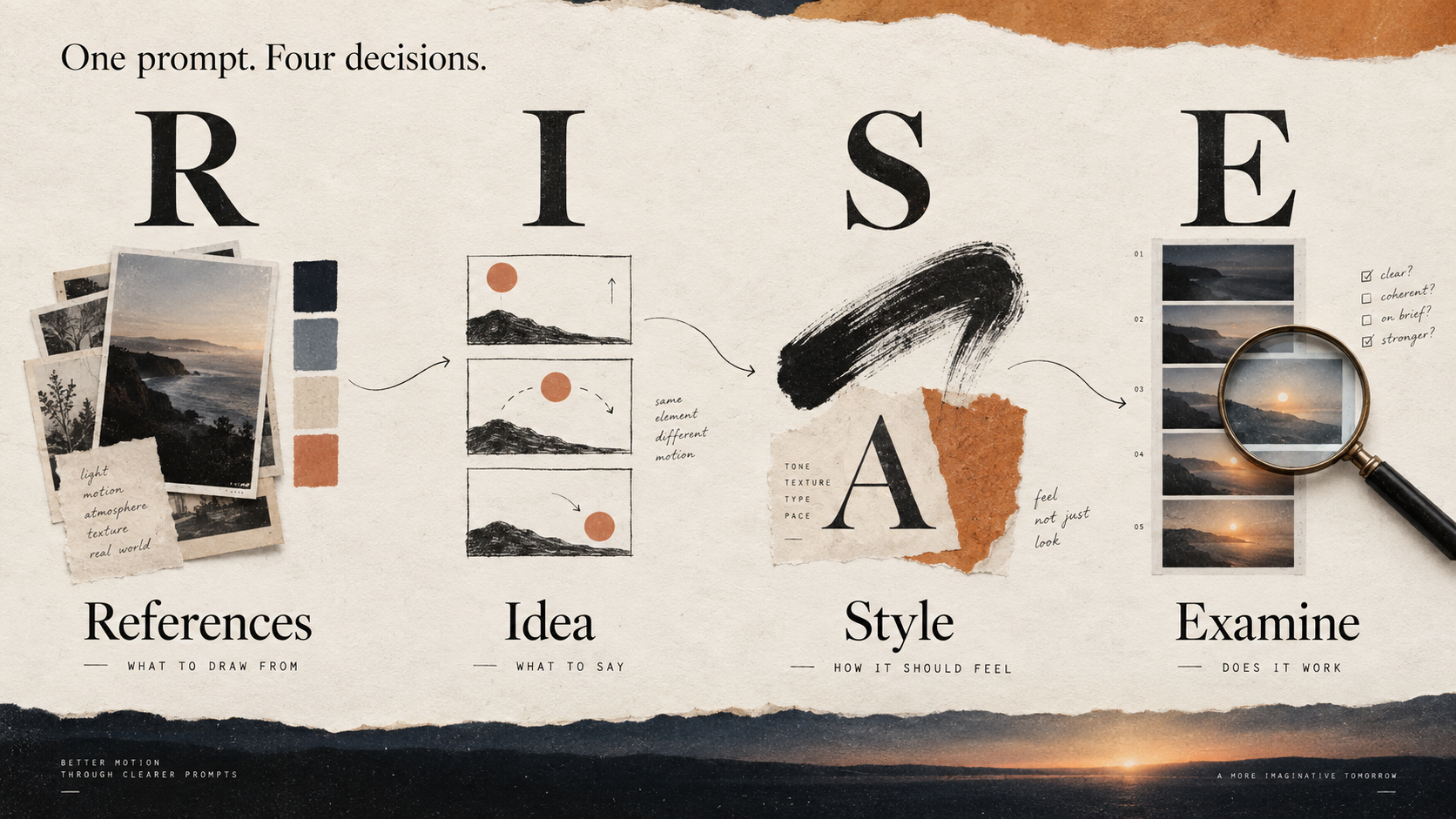
R · Start with a real reference
Attach the image or clip you want it to work from. For a website, use Firecrawl's branding output to bring in the logo, colours and fonts.
R: Here is [yoursite.com]. Firecrawl pulled its logo, colours and fonts (attached). Use them exactly. I've also attached [a screenshot, a clip or a reference image].
curl -s https://api.firecrawl.dev/v2/scrape \
  -H "Authorization: Bearer $FIRECRAWL_API_KEY" \
  -H "Content-Type: application/json" \
  -d '{"url": "https://yoursite.com", "formats": ["branding"]}'
I · One image with beginning, middle & end
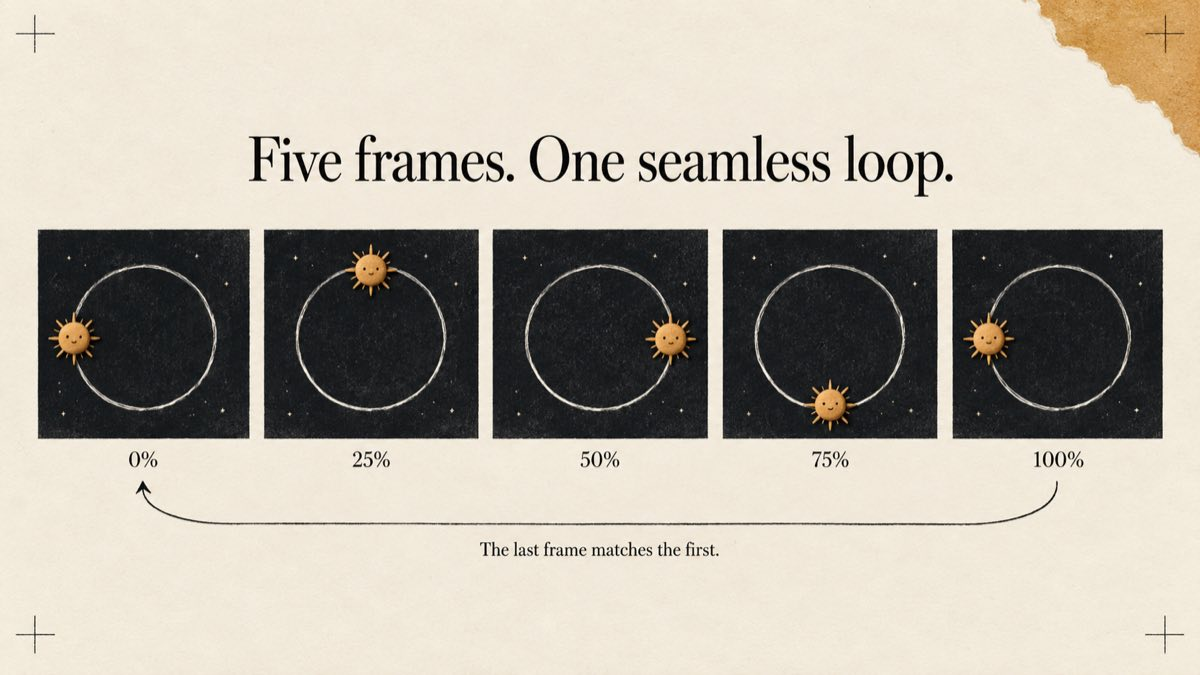
Give the scene one clear change. Then bring it back to its starting frame so the loop is seamless.
I: One image, 10 seconds. Beginning: [what we see first]. Middle: [the one change]. End: [how it lands]. The last frame matches the first.
S · One style: how it looks, how it moves
Choose how it looks and how it moves. Name the colours, type and texture, then specify the pace and which element moves first.
Ink on ivory: Looks: ivory paper, an ink line, one clay sun. Moves: slow, eased in and out.
Risograph: Looks: two riso inks on black stock. Moves: 12 frames a second, snappy, off register.
S: Looks like [ground], [ink], one [accent], [font], real grain. Moves [slow or snappy], eased in and out; [what moves first].
E · Check five frames. Fix what's off.
Render the frames at 0%, 25%, 50%, 75% and 100%. Check each one, fix what looks wrong, and render again.
E: Draw every frame in code from one render(t) function. Add real texture so it feels hand-made. Before you stop, check the frames at 0%, 25%, 50%, 75% and 100%, and fix anything that looks off.
02 / Seven recipes to try
Complete prompt recipes ready to adapt. Swap in your own references, domain assets, or footage.
R: Here is my slide (screenshot attached).
I: A 10-second loop that explains its point: a beam of light runs along a timeline and lights three milestones.
S: Looks like ivory paper, black ink lines, one clay-orange accent. Moves slow and eased; the last frame matches the first. 1920x1080.
E: Draw every frame in code from one render(t) function. Add real texture so it feels hand-made. Before you stop, check the frames at 0%, 25%, 50%, 75% and 100%, and fix anything that looks off.R: Here is glaido.com. Firecrawl pulled its colours, fonts, logo and copy (attached).
I: The hero: a voice wave turns into lime birds that fly into a text field and become typed words. Keep the headline, subline and button as real HTML text. Add a footer where the birds form the Glaido wordmark behind normal links.
S: Looks like Glaido's own colours, fonts and paper texture. Moves calm; the birds follow the cursor gently and scatter on click.
E: Draw every frame in code from one render(t) function. Add real texture so it feels hand-made. Before you stop, check the frames at 0%, 25%, 50%, 75% and 100%, and fix anything that looks off.R: Frames from one of my reels, plus a 10-second clip of me talking with word timings.
I: Top half: an animated graphic for "Stop using Claude and ChatGPT separately. Use them together." Bottom half: my clip.
S: Looks dark, with the real Claude and ChatGPT logos and big type. Moves: the two logos pull together and lock. Captions: max 3 words, word-timed, the spoken word lights up. Three caption looks: editorial serif, boxed heavy sans, and one premium look you choose. 1080x1920.
E: Draw every frame in code from one render(t) function. Add real texture so it feels hand-made. Before you stop, check the frames at 0%, 25%, 50%, 75% and 100%, and fix anything that looks off.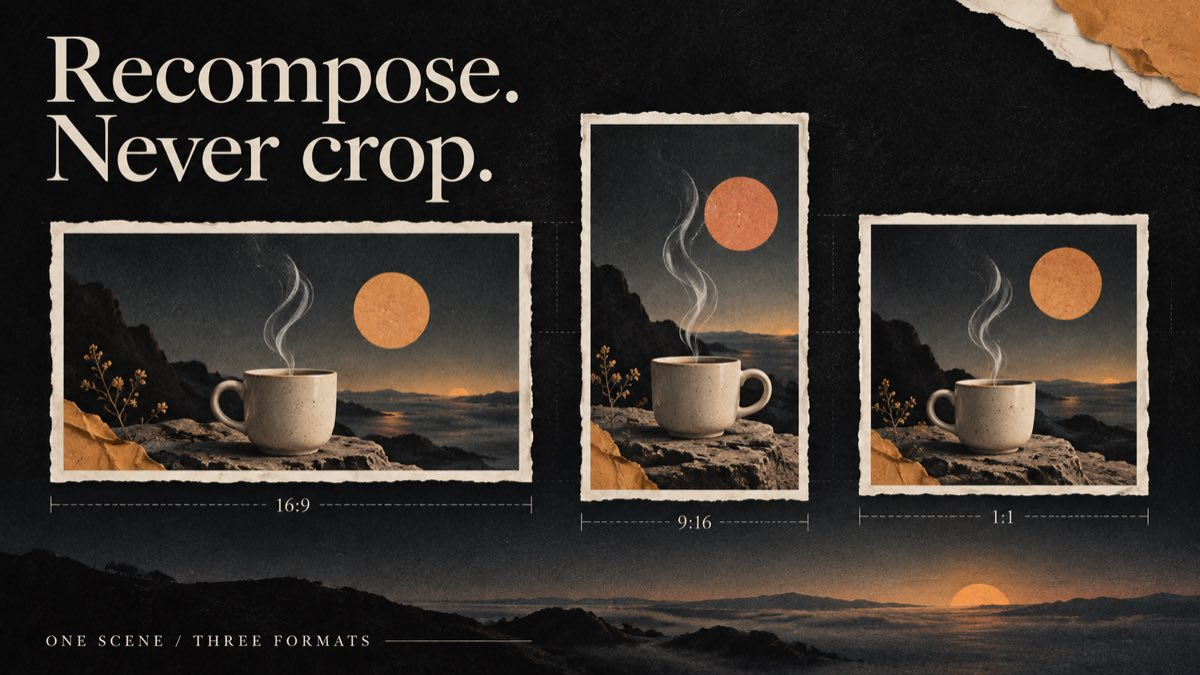
R: My voiceover ends: "With enough coffee, anything is possible."
I: A coffee cup whose steam draws a YouTube screen, an Instagram screen and an X post, each with a tiny living scene, then curls back into the cup.
S: Looks dark editorial with warm coffee light. Moves smooth, 10 seconds, and the last frame matches the first. ONE scene that re-lays itself for 16:9, 9:16 and 1:1 (never a crop). Put const DRINK = 'coffee' at the top so I can change it.
E: Draw every frame in code from one render(t) function. Add real texture so it feels hand-made. Before you stop, check the frames at 0%, 25%, 50%, 75% and 100%, and fix anything that looks off.R: The logos Firecrawl pulled from notion.com, duolingo.com, spotify.com and nike.com.
I: A 5-second reveal for each, a different idea per brand: Notion blocks assemble, Duolingo bounces, Spotify's arcs pulse to the beat, Nike's swoosh strikes.
S: Looks: exact logo shapes and colours. Moves with each brand's own energy. Write a 3-second jingle for each in code, locked to the motion. Start muted.
E: Draw every frame in code from one render(t) function. Add real texture so it feels hand-made. Before you stop, check the frames at 0%, 25%, 50%, 75% and 100%, and fix anything that looks off.R: This reference image: <Savee link>.
I: A 10-second explainer: "How Firecrawl reads a website: URL in; logo, colours and fonts out."
S: Take the reference's style (palette, type, texture, composition), not the picture. First write how it looks and how it would move, then build it.
E: Draw every frame in code from one render(t) function. Add real texture so it feels hand-made. Before you stop, check the frames at 0%, 25%, 50%, 75% and 100%, and fix anything that looks off.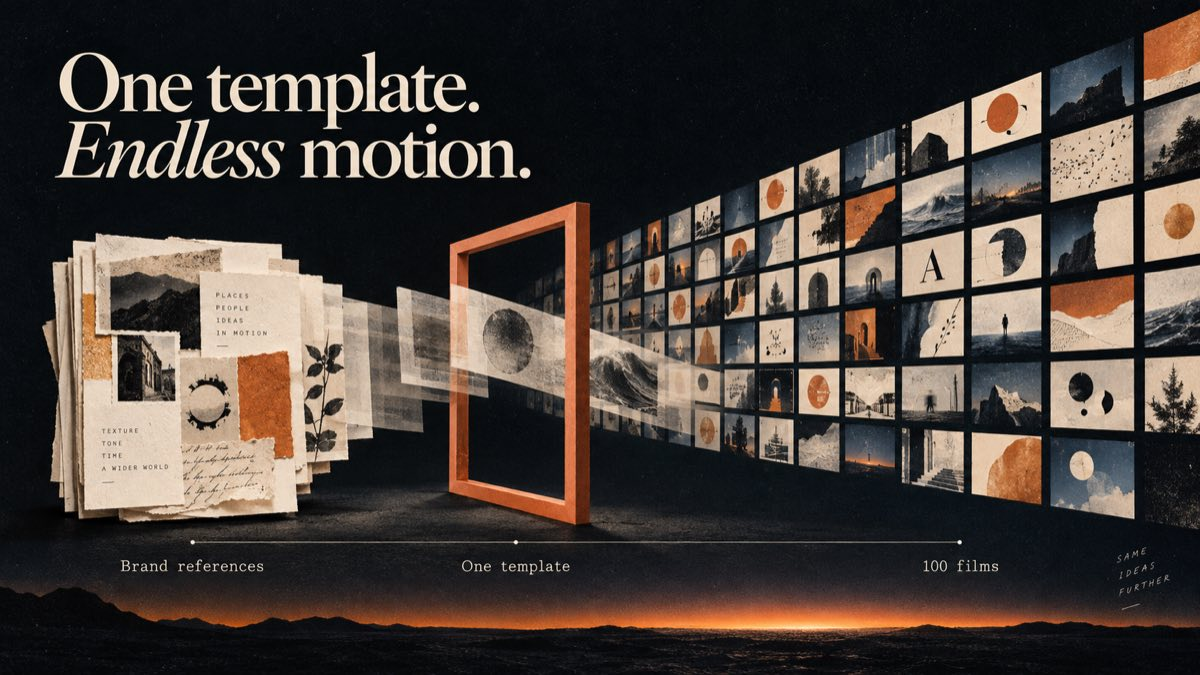
R: sites.txt has 100 websites. Use Firecrawl to pull each brand: name, logo, 2-3 colours, font.
I: One 8-second template, "{Name}, in motion", that looks good for any brand.
S: Looks premium, with auto contrast for light and dark logos. Moves: the logo strikes in, the colours sweep, the line lands. Render all 100 as 1080x1080 mp4s with headless Chrome and ffmpeg, then a 10x10 wall video. Test on 5 first.
E: Draw every frame in code from one render(t) function. Add real texture so it feels hand-made. Before you stop, check the frames at 0%, 25%, 50%, 75% and 100%, and fix anything that looks off.03 / Pick a visual style
Select a tailored design system. Each style provides five governing rules, palette specifications, and a complete ready-to-run prompt.
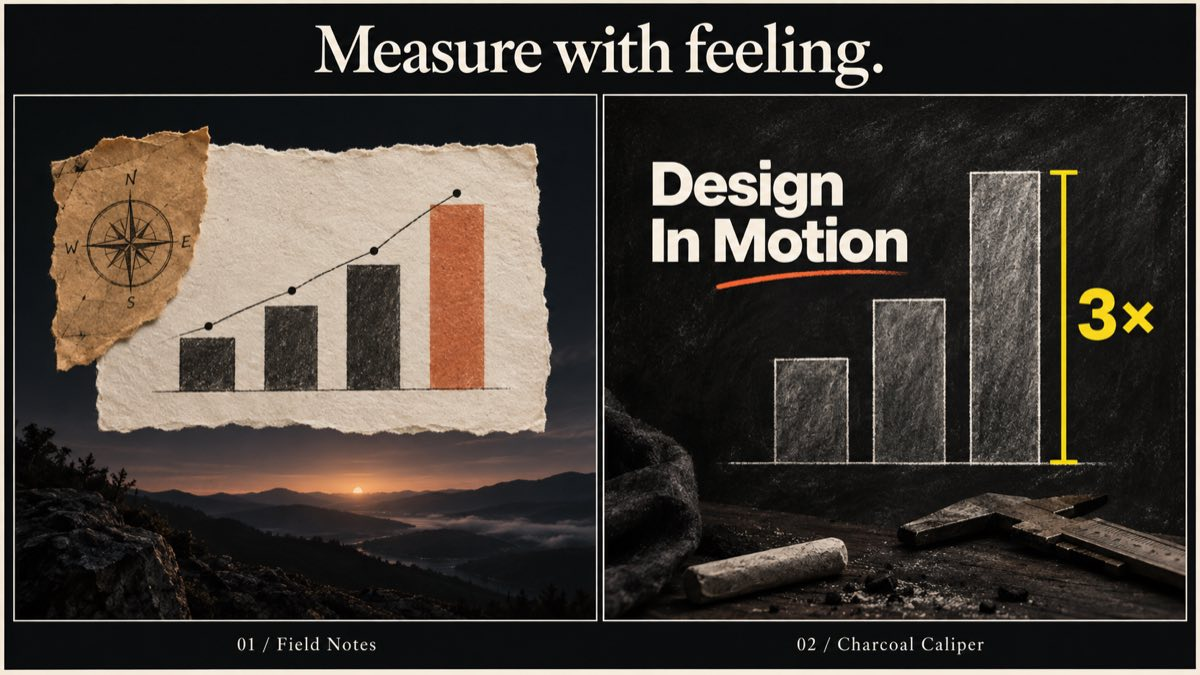
- The slide is real paper: ivory tooth, soft shadow, light falling across it.
- Bars rise only as the beam passes them, eased out, never all at once.
- One clay bar, the last and tallest; every other bar is ink.
- The trend line draws after the bars land, with round dots on each top.
- Title in Newsreader 500 at opsz 36, a short clay rule above it.
R — References
• Editorial chart slides: one idea, one highlighted bar, generous margins.
• The Horizon Strike look: night ground, dawn planet rim, ivory paper, torn ochre collage, one clay accent.

I — Idea
One image with a beginning, middle and end, 5 seconds, looping seamlessly:
• Beginning (0–1.8 s): an ivory slide titled "Numbers that move" floats on night; a soft clay beam sweeps left to right and each bar rises as the beam passes.
• Middle (1.8–3.9 s): an ink trend line draws through the bar tops, a clay nib resting on the last, tallest bar.
• End (3.9–5 s): the bars settle back to the baseline in a stagger and the slide waits for the next sweep.

S — Style
Looks: #07080c night with a dawn rim at the foot; an ivory paper slide with a soft shadow; ink bars in the ground colour; the tallest bar in #d97757; a #e3b23c torn scrap with an ink compass sketch in the corner; Newsreader 500 title at opsz 36.
Moves: beam sweep 1.6 s with an ease-in-out; bars ease out over 0.8 s after the beam passes; trend line draws by length; settle staggered 60 ms per bar.
Rules:
1. Paper texture, shadow and light falloff on the slide.
2. Bars rise only when the beam reaches them.
3. One clay bar; everything else is ink.
4. Dots on the trend line, drawn after the bars land.
5. Grain and vignette over everything.

E — Examine
Build one HTML file: a <canvas> and one pure function render(ctx, t, theme, w, h) that draws frame t (0–5 s) from theme {bg, ink, accent, accent2, font}. Same t, same frame, in any order; seeded hash, no Math.random. Must work at 16:9, 9:16 and 1:1.
Render 5 frames (t = 0, 1.25, 2.5, 3.75, 5). Check: frame 0 equals frame 5; no bar rises before the beam reaches it; the trend line meets every bar top; the title never clips; the slide never touches the frame edge. Fix what fails and render again until every check passes.- Two type sizes only: a label size and a stat 2.6 times bigger.
- Title Case, heavy grotesque, white; never all caps, never coloured type.
- The caliper spans the full height it claims and draws before its stat pops.
- The stat pops 80 ms after the bracket: 0.85 to 1, no fade.
- Orange only as strokes: one cursive swash under one title word, once.
R — References
• Vox-school documentary explainers: a charcoal chalkboard field, white heavy grotesque type, yellow measurement brackets.
• Field-guide plates: one subject, one measured fact.
• Take the grammar, never any network's marks.

I — Idea
One image with a beginning, middle and end, 5 seconds, looping on a hard cut:
• Beginning (0–1.4 s): the title "Design In Motion" sits on a smudged charcoal board; a baseline draws and three bars rise, one beat each.
• Middle (1.4–3.1 s): a yellow caliper measures the tallest bar, then the stat "3×" pops beside it; an orange cursive swash underlines one title word.
• End (3.1–5 s): a dead hold of at least 1.5 s, then a single-frame hard cut back to the title alone.

S — Style
Looks: #0d0d0d charcoal board with chalk smudges and dust, #f4f1ea Plus Jakarta Sans ExtraBold in Title Case, bars as translucent #f4f1ea fills with a 2 px #f4f1ea outline, a #f5e918 caliper, one #f0862b swash.
Moves: every build is 300–450 ms quint-out, one per beat, then frozen. The caliper draws in 400 ms, the stat pops 80 ms later (0.85 to 1, outBack, no fade). The swash draws in 450 ms. The plate pushes in to 1.05 over the scene.
Rules:
1. Two type sizes only; the stat is 2.6 times the label.
2. The caliper spans exactly the bar's full height, ticks toward the bar, tab toward the stat.
3. Accents are strokes only, under 0.5% of the frame each, never more than two.
4. No rings, circles or ellipses anywhere.
5. The board is never flat: luminance varies a little everywhere.
6. Dead hold at the end, then a hard cut (no crossfade).

E — Examine
Build one HTML file: a <canvas> and one pure function render(ctx, t, theme, w, h) that draws frame t (0–5 s) from theme {bg, ink, accent, accent2, font}. Same t, same frame, in any order; seeded hash, no Math.random. Must work at 16:9, 9:16 and 1:1.
Render 5 frames (t = 0, 1.25, 2.5, 3.75, 5). Check: frame 0 equals frame 5; only two type sizes; the bracket ends exactly at the bar's top and baseline; the stat sits mid-cap on the tab; the swash is under one word only; the board is not flat. Fix what fails and render again until every check passes.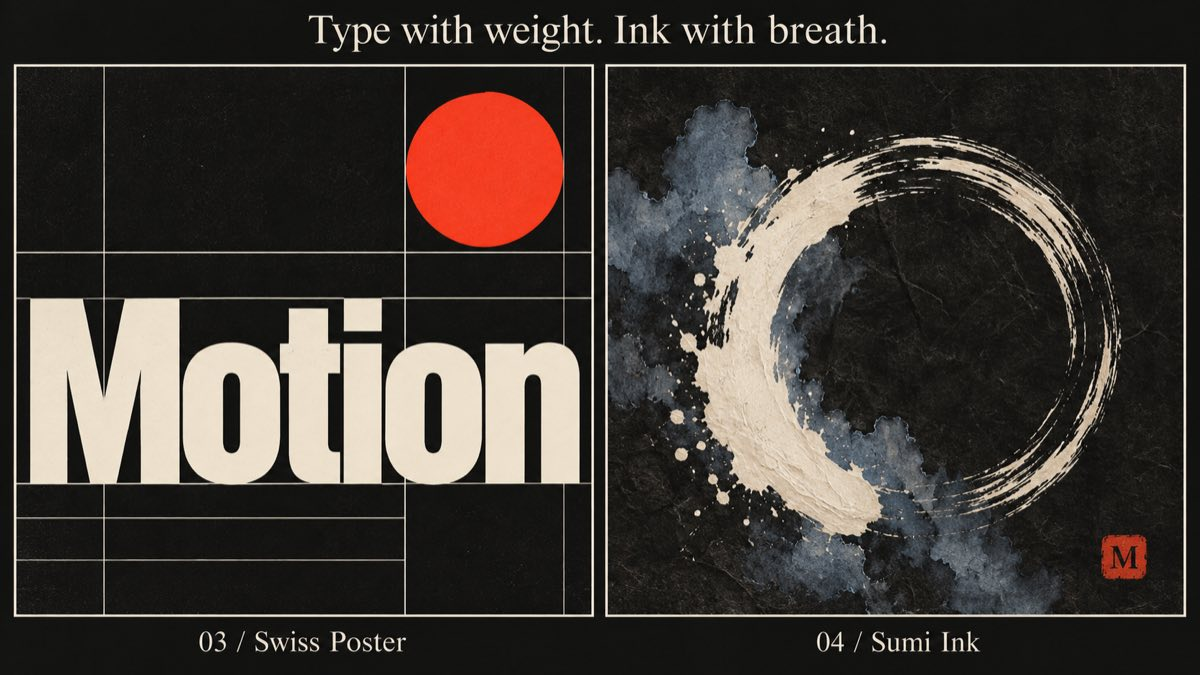
- Everything snaps to a 12-column grid; nothing floats.
- One huge word, set tight (-2% tracking), flush left on the baseline.
- One red disc is the only colour; everything else is ink.
- Letters enter from a baseline mask, staggered 60 ms, quint-out.
- Weight is the motion: a wave of 260 to 860 travels through the word.
R — References
• Josef Müller-Brockmann and the International Typographic Style: strict grids, asymmetric balance, one bold colour.
• Variable-font "weight wave" type animations (search: variable font kinetic typography).
• Match their discipline, not their layouts.

I — Idea
One image, told in 5 seconds, looping seamlessly:
• Beginning (0–1.3 s): an empty grid with a red disc; the word "Motion" rises letter by letter out of a mask on the baseline.
• Middle (1.3–3.9 s): the word holds while a weight wave travels through its letters; the disc steps to a new grid position on each beat.
• End (3.9–5 s): the letters lift out through the top of the mask, the rule retracts, and the frame is back where it began.

S — Style
Looks: #0f0f0e ground, #f1eee7 type and hairlines, one #ff3b1f disc. Inter, heavy, tracking -2%, flush left on a 12-column grid with generous margins. Tiny captions in the same family.
Moves: quint-out entrances staggered 60 ms, a sine weight wave (260 to 860, two waves per loop), beat-locked disc moves of 0.7 s. Ease in and out, never linear.
Rules:
1. Every element sits on the grid: columns, baseline, margins.
2. One huge word; it fills about 85% of the grid width.
3. The disc is the only colour.
4. Letters enter from a baseline mask, staggered; they exit the same way, upward.
5. The weight wave is the motion; positions only change on entrances and exits.
6. Grain and a soft light falloff so the ground is never flat.
7. Hold the full word at least 1.2 s.

E — Examine
Build one HTML file: a <canvas> and one pure function render(ctx, t, theme, w, h) that draws frame t (0–5 s) from theme {bg, ink, accent, accent2, font}. Same t, same frame, in any order; seeded hash, no Math.random. Must work at 16:9, 9:16 and 1:1.
Render 5 frames (t = 0, 1.25, 2.5, 3.75, 5). Check: frame 0 equals frame 5; the word fits with no clipped letters; the disc lands exactly on grid points; captions never collide with the word; the weight wave reads as one smooth wave. Fix what fails and render again until every check passes.- One brush stroke, one breath: slow landing, fast middle, slow lift.
- Width follows pressure: a pressed blob at the start, a dry split tail.
- Dry-brush gaps open only in the last third of the stroke.
- The bloom spreads after the stroke, most where the brush was wettest.
- Every bloom edge carries a tide line, never a clean blur.
R — References
• Zen ensō calligraphy (search: ensō brush painting, kasure dry brush).
• Ink dropped on wet rice paper (nijimi bleeding with a tide-line edge).
• A carved red hanko seal stamped once in the corner.

I — Idea
One image, one breath, 5 seconds, looping seamlessly:
• Beginning (0–1.9 s): a loaded brush lands on dark wet paper and sweeps one circle, fast in the middle, slow at both ends, splitting into dry bristles at the tail.
• Middle (1.9–3.9 s): ink bleeds outward into the paper and a vermilion seal carrying the initial of "Motion" stamps down once, hard.
• End (3.9–5 s): the ink dries back to a faint ghost of the circle, which is where the next stroke begins.

S — Style
Looks: #0d0c0b paper with visible fibres and mottling, luminous #ede6d8 ink, a cool #7f93a8 bloom, a small #d8432f seal with the letter carved out in Newsreader. Generous empty space around one circle.
Moves: brush speed ease-in-out over 1.6 s; the bloom grows after the stroke with a feathered noise edge; the seal scales 1.2 to 1 in 0.25 s; the fade to ghost eases out.
Rules:
1. One stroke, drawn as a filled shape whose width follows brush pressure.
2. Dry-brush gaps (thin streaks of paper) only in the last third.
3. Bloom = soft wash + a brighter tide-line rim at its edge, driven by noise.
4. More bleed where the brush was wet (the start), less at the dry tail.
5. Spatter: a few dots flicked outward where the brush lands.
6. The seal is the only colour and stamps once.
7. Paper texture, light falloff and grain on every frame.

E — Examine
Build one HTML file: a <canvas> and one pure function render(ctx, t, theme, w, h) that draws frame t (0–5 s) from theme {bg, ink, accent, accent2, font}. Same t, same frame, in any order; seeded hash, no Math.random. Must work at 16:9, 9:16 and 1:1.
Render 5 frames (t = 0, 1.25, 2.5, 3.75, 5). Check: frame 0 equals frame 5; the stroke width really tapers; the bloom has a rim, not a blur; the seal letter is crisp and not clipped; the paper is never a flat colour. Fix what fails and render again until every check passes.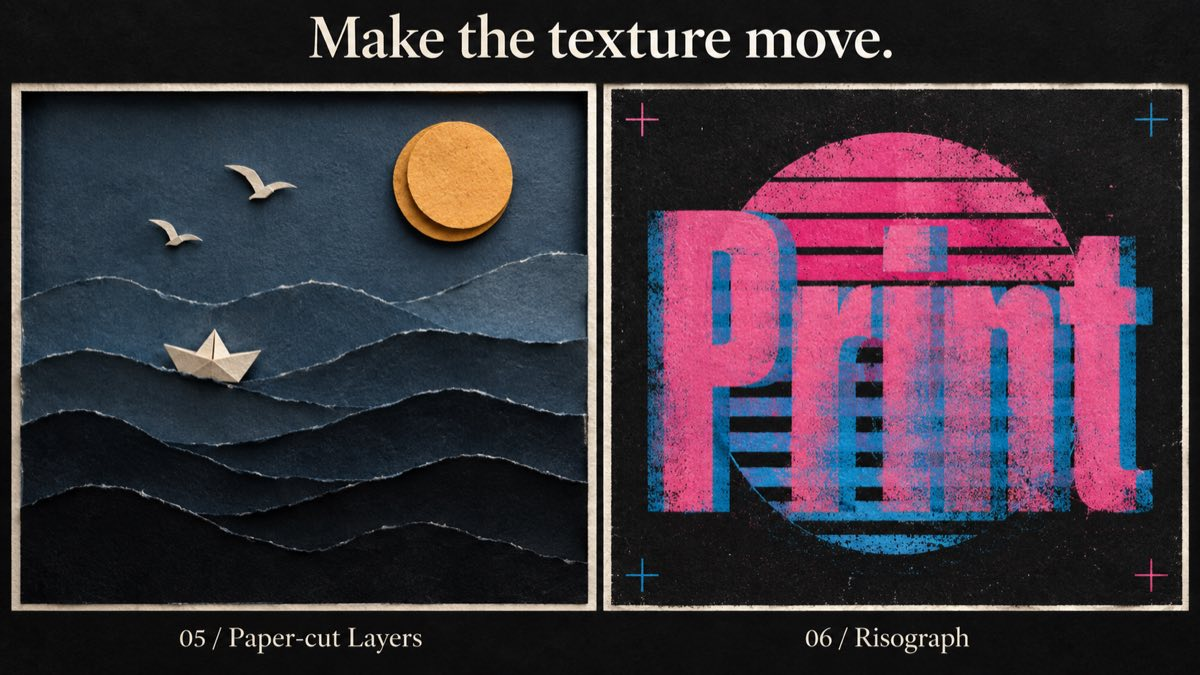
- Every shape is a cut layer that casts a soft shadow on the one behind.
- Layers get lighter with distance: atmospheric perspective in paper.
- Edges are scissor-cut: slightly irregular, never perfect curves.
- A thin light catches the top edge of every layer.
- Layers move at different speeds and alternate direction (parallax).
R — References
• Layered paper-cut dioramas and shadow boxes (search: layered paper art ocean, paper cut shadow box).
• Paper theatre sets; stop-motion paper craft lit from above.

I — Idea
One image, a quiet night at sea, 5 seconds, looping seamlessly:
• Beginning (0–1.5 s): six cut-paper wave layers roll under a layered paper moon; a folded paper boat rides the second wave.
• Middle (1.5–3.5 s): the boat lifts and tips on a swell, two paper birds glide across, stars wink.
• End (3.5–5 s): the swell settles and every layer lands exactly where it began.

S — Style
Looks: #0e1016 night, layers graded from #4f7396 (far) to near-black (near), each with a soft drop shadow and a lit top edge; the moon in #f2a541 with two paper rings; the boat and birds in #f2e8d8. Paper fibre texture on everything.
Moves: each layer scrolls a whole number of wavelengths per loop, alternating direction; gentle sine bob; the boat follows its wave's height and slope.
Rules:
1. Every layer casts a shadow onto the layer behind it.
2. Farther layers are lighter and bluer.
3. Irregular scissor-cut edges.
4. A thin lit edge along each layer's top.
5. Parallax: different speeds, alternating directions.
6. One accent, in the moon.

E — Examine
Build one HTML file: a <canvas> and one pure function render(ctx, t, theme, w, h) that draws frame t (0–5 s) from theme {bg, ink, accent, accent2, font}. Same t, same frame, in any order; seeded hash, no Math.random. Must work at 16:9, 9:16 and 1:1.
Render 5 frames (t = 0, 1.25, 2.5, 3.75, 5). Check: frame 0 equals frame 5; every layer has a visible shadow; the boat sits on its wave (never floating or sunk); no layer edge looks machine-perfect; paper texture is visible. Fix what fails and render again until every check passes.- Exactly two inks; overlaps screen into a third colour.
- Every ink layer prints: dropout speckles and uneven density.
- The two plates sit slightly out of register and jitter per frame.
- Animate on twos: 12 printed frames a second, fresh grain each frame.
- One huge condensed word, repeated as a marquee.
R — References
• Risograph prints and zines (search: risograph two colour print, fluorescent pink riso).
• Riso stop-motion animations: each frame printed, grain changing frame to frame.

I — Idea
One image with a beginning, middle and end, 5 seconds, looping seamlessly:
• Beginning (0–1.5 s): a striped sun sits low in the frame; a giant condensed marquee reading "Print" starts sliding across it.
• Middle (1.5–3.5 s): the sun rises through the marquee; where the inks overlap they screen into a third colour; a small second marquee runs the other way.
• End (3.5–5 s): the sun sets back to where it began and both marquees land exactly one repeat along.

S — Style
Looks: #111111 black stock with fibres; ink one #ff48b0, ink two #1f9bd1; Anton set huge and condensed; registration marks at the corners.
Moves: everything steps at 12 fps; marquees move exactly one repeat per loop; the plates jitter out of register by a fraction of a percent each printed frame.
Rules:
1. Two inks only, blended with screen on the dark stock.
2. Dropout speckles and uneven density on every ink layer.
3. Misregistration: one plate offset and jittering.
4. 12 fps stepped motion; new grain per frame.
5. Stripes or grain for gradients.

E — Examine
Build one HTML file: a <canvas> and one pure function render(ctx, t, theme, w, h) that draws frame t (0–5 s) from theme {bg, ink, accent, accent2, font}. Same t, same frame, in any order; seeded hash, no Math.random. Must work at 16:9, 9:16 and 1:1.
Render 5 frames (t = 0, 1.25, 2.5, 3.75, 5). Check: frame 0 equals frame 5; exactly two inks plus their overlap; the grain is visible at full size; the marquee wraps without a jump; the misregistration is subtle, not broken. Fix what fails and render again until every check passes.04 / Check before you ship
Never deliver or export motion graphics without verifying every frame against these 10 quality defects.
Before you stop, check every frame for these ten tells and fix any you find:
1. Clipped letters: line height 1.1 or more. Check every g, j, p, q and y.
2. A word alone on a line: rewrite the line, or tie the last two words together.
3. Empty stage: the visual fills 80 to 95% of the stage.
4. Flat colour: light falls off across the frame. No single flat fill.
5. Linear motion: ease in and out. Nothing moves at one constant speed.
6. Loop seams: the last frame matches the first, pixel for pixel.
7. Text held too short: hold every word on screen for at least 1.2 seconds.
8. Fake logos: use the real file. Never draw a logo from memory.
9. Busy backgrounds: one idea on a quiet ground.
10. No texture: real grain and subtle noise, so it feels made by hand.05 / Interactive Motion Studio
A real-time execution of the RISE architecture running a pure render(ctx, t, style, w, h) function inside HTML5 canvas.